
Freight Dispatcher Explained: What They Actually Do
What does a freight dispatcher really do? Finding freight, negotiating rates, rate cons, TONU, detention, lumpers, and compliance — and why dispatched owner-operators earn more.
TRUCK DISPATCHERTRUCKING INDUSTRY
Five Star Dispatching
7/14/20267 min read
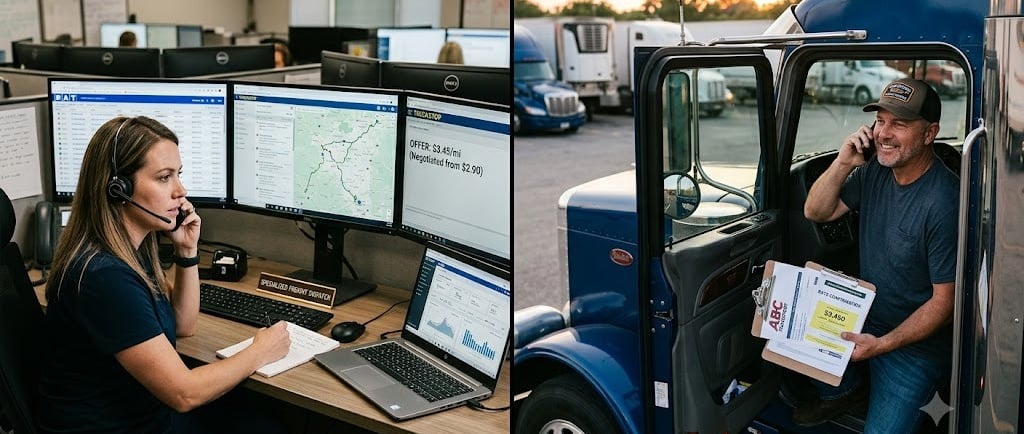
Freight Dispatcher Explained: What They Actually Do (And Why Dispatched Owner-Operators Make More Money)
Most owner-operators think a freight dispatcher just finds loads.
That's maybe 20% of the job — and it's not the 20% that makes you money. The rest is negotiation, paperwork, and a long list of things you're owed but probably aren't collecting: TONU when a load evaporates. Detention when a shipper burns four hours of your day. Lumper fees you paid out of pocket and never got back.
That's the gap. Not the load — the money around the load. Here's exactly what a freight dispatcher does, line by line, and where the difference actually shows up in your settlement.
First, the Terms
You'll see this role called a freight dispatcher, a trucking dispatcher, a truck dispatcher, or a cargo dispatcher. Same job. The industry uses them interchangeably, so don't get hung up on the label.
One distinction that does matter: a dispatcher is not a broker. A broker is FMCSA-licensed and works for the shipper. A dispatcher works for you — the carrier — and negotiates against brokers on your behalf. Same freight, opposite sides of the table. Full breakdown here.
1. Finding Freight (The Part Everyone Knows)
Yes, dispatchers work the load boards — DAT, Truckstop, and the rest. But if that's all they do, you're paying for a search engine with a phone number.
Real freight-finding means:
Knowing the lane rate before the call. Rate data (like DAT's RateView) tells you what a lane has actually been paying. Walking into a negotiation without it is guessing.
Working a broker network, not just a board. The best-paying loads often never get posted publicly — they go to carriers a broker already trusts.
Thinking in round trips. A great rate into a dead market is a bad load. Deadhead is pure loss, and a dispatcher plans the reload before you drop the current one.
Moving fast. Good loads get buried in calls within minutes. You're driving. Your dispatcher isn't.
More on where the best loads actually come from.
2. Negotiation (The Part That Pays)
The posted rate is an opening offer. Brokers pad it expecting a counter. Drivers who don't push back fund everyone who does.
A dispatcher negotiating properly is arguing from data, not feelings — "this lane has been averaging $2.65, you're offering $2.10" is a different conversation than "that seems low." They also negotiate the whole deal, not just linehaul: detention terms, tarp pay on flatbed, fuel surcharge on power-only, layover, and who's covering the lumper.
The math: even $0.20/mile more, across 8,000 miles a month, is $1,600. Every month. That's the entire argument for professional negotiation in one line.
3. Broker Setup and Vetting (Before You Roll)
Before you haul for a broker, someone has to complete the carrier packet — your MC authority, W-9, insurance certificate, notarized forms, banking or factoring info. It's tedious, it's repetitive, and it's per-broker.
More importantly, someone has to check whether the broker actually pays. A $3.00/mile rate from a broker with a 90-day payment history — or no payment history — is not a good load. Credit scores and days-to-pay get checked before the load, not after you're chasing an invoice.
And in 2026, double-brokering and freight fraud are everywhere. Vetting isn't paranoia. It's the difference between getting paid and joining a lawsuit.
4. Rate Confirmations (Read Every Line)
The rate confirmation ("rate con") is the contract. Once you sign it, the terms are the terms — and what's not written on it doesn't exist.
A dispatcher reads every rate con for:
The linehaul rate and total pay — does it match what was verbally agreed?
Detention terms — after how many free hours, at what hourly rate, and capped at what?
Accessorials — tarp pay, layover, stop-off pay, TONU terms.
Lumper reimbursement — who pays, and how you get it back.
Appointment windows and penalties for missing them.
Anything that quietly shifts liability onto you.
Verbal promises don't survive a settlement dispute. If a broker says "we'll take care of you on detention" and it's not on the rate con, you have nothing. This is where most owner-operators lose money — not on the rate, but on the paperwork they didn't read closely.
5. TONU: Getting Paid When the Load Disappears
TONU = Truck Order Not Used. The load gets cancelled after you've already committed — you've deadheaded to the shipper, you're at the dock, and suddenly there's no freight.
You are often entitled to compensation for that. TONU pay commonly runs in the $150–$250 range (sometimes more, sometimes a percentage of the linehaul), depending on the broker and what was negotiated.
Here's the problem: most owner-operators never claim it. They take the cancellation, grumble, and go find another load. But TONU has to be asked for — and ideally the terms should already be on the rate con before you ever roll.
A dispatcher claims it. Every time. Two or three TONUs a year that you didn't collect is real money quietly gone.
6. Detention: The Money Bleeding Out at the Dock
This is the biggest silent loss in trucking.
You show up on time. The shipper takes six hours. That's most of a working day — burning your clock, your HOS, and your next load's appointment — and unless someone claims it, you get paid nothing for it.
Detention typically kicks in after 2 hours of free time, at rates commonly around $25–$75/hour, often with a daily cap. But the money isn't automatic. You have to:
Have detention terms on the rate confirmation before you roll,
Document your arrival and departure (in/out times, signed BOL, gate logs, ELD data),
Notify the broker as it's happening — not three days later,
And then actually submit and chase the claim.
Miss any of those steps and the claim dies. That's a full workflow — while you're sitting at a dock, tired, waiting.
This is exactly the kind of money a dispatcher exists to recover. They're watching the clock, notifying the broker at the free-time mark, and filing the claim with the documentation attached. You just drive.
7. Lumper Fees: Don't Eat That Cost
At many grocery and retail warehouses, you'll be told to pay a lumper — a third-party crew that loads or unloads the trailer. Fees commonly run $150–$500+, and they want payment on the spot.
That cost is not yours to absorb. Lumper fees are typically reimbursed by the broker or shipper — but only if:
Reimbursement is agreed and on the rate con (or confirmed in writing) before you pay,
You get a proper lumper receipt, and
You submit it with your paperwork.
Pay a lumper without confirming reimbursement and you may simply be out the money. It's one of the most common ways new owner-operators lose a few hundred dollars and never see it again.
A dispatcher confirms reimbursement before you hand over a dollar, and makes sure the receipt gets where it needs to go.
8. Paperwork and Settlements
The unglamorous engine of the whole business:
BOLs and PODs — signed, photographed, submitted. No POD, no pay.
Rate cons and invoices matched against what was actually agreed.
Accessorial claims — detention, TONU, layover, lumper — filed with documentation.
Factoring submissions, if you factor.
Chasing late payment when a broker sits on an invoice.
This is hours a week. It's also where the money you earned either gets collected or quietly doesn't.
9. Compliance: The Stuff That Shuts You Down
You own the authority, so compliance is ultimately on you — but a good dispatcher keeps it from becoming a crisis:
Active MC/DOT authority, BOC-3, and UCR registration kept current.
Insurance certificates on file and not lapsed — an expired COI kills broker setups instantly.
Hours of Service respected when booking. A dispatcher who books you a load you cannot legally run is a liability, not an asset.
IFTA fuel tax reporting deadlines.
Drug & Alcohol Clearinghouse queries and CDL medical currency.
CSA scores — inspections and violations that affect which brokers will even work with you.
A dispatcher who books around your clock instead of against it is protecting your authority — and your license.
Why Dispatched Owner-Operators Make More Money
Add it up. It isn't one big win — it's a stack of small ones you're currently leaving on the table:
Where the money isWhat it's worthNegotiating +$0.20/mile instead of taking posted rates~$1,600/mo at 8,000 milesCutting deadhead with planned backhaulsHundreds per week in recovered milesClaiming detention instead of eating it$50–$300+ per incidentClaiming TONU instead of shrugging$150–$250+ per cancellationGetting lumpers reimbursed instead of absorbed$150–$500+ per occurrenceVetting brokers so you actually get paidThe whole invoiceYour hours backPriceless, and the reason you bought the truck
None of these require luck. They require someone whose full-time job is watching for them — while you're doing the one thing that only you can do: driving.
That's the entire case for a dispatcher, and it has nothing to do with load boards.
Where Five Star Dispatching Comes In
We do all nine jobs above. We find your freight and negotiate every rate with the data in front of us. We vet the brokers before you roll. We read every rate confirmation line by line. We claim your detention, your TONU, your lumper reimbursements, and your accessorials — because that's your money, not the broker's. We handle the setups and the paperwork, and we book around your clock, not against it.
You keep your authority. You keep the final say on every load. We dispatch dry van, reefer, flatbed, power only, and hotshot for owner-operators and small fleets nationwide.
Stop searching load boards all day. Let our dispatchers handle it while you stay on the road making money. 👉 Visit fivestardispatching.com and let's get your wheels turning.
Frequently Asked Questions
What does a freight dispatcher do?
A freight dispatcher finds and books loads, negotiates rates, completes broker setups, reads and verifies rate confirmations, claims accessorials (detention, TONU, lumper), handles paperwork, and keeps the carrier compliant and loaded — while the owner-operator keeps their authority and the final say.
What is TONU in trucking?
TONU means "Truck Order Not Used" — compensation owed when a load is cancelled after you've already committed or arrived. It commonly runs $150–$250 or more, but it usually has to be claimed, and the terms should be on the rate confirmation before you roll.
How does detention pay work?
Detention typically starts after about 2 hours of free time at a shipper or receiver, commonly at $25–$75/hour with a cap. To collect, the terms must be on the rate con, your in/out times must be documented, the broker must be notified promptly, and the claim must be filed with proof.
Who pays lumper fees?
Lumper fees are typically reimbursed by the broker or shipper — but only if reimbursement is agreed in writing beforehand and you submit a proper receipt. Pay one without confirming reimbursement and you may never see the money.
Is a freight dispatcher the same as a trucking dispatcher?
Yes. Freight dispatcher, trucking dispatcher, truck dispatcher, and cargo dispatcher all describe the same role. A dispatcher is not a freight broker — a broker works for the shipper; a dispatcher works for you.
Do I keep my authority with a dispatch service?
Yes. A dispatch service works for you — you keep your MC authority and approve every load. The dispatcher handles the hunting, negotiating, paperwork, and claims.
Do dispatchers really make owner-operators more money?
They can, through a stack of gains: better negotiated rates, less deadhead, and accessorials (detention, TONU, lumpers) that most owner-operators never claim — plus the driving hours you get back instead of spending them on load boards.
Reach out anytime for reliable dispatch support.
Conect Now
Newesletter
© 2025. All rights reserved.

