
DAT Load Board 2026: Pricing, Features, Pros & Cons
A straight review of the DAT load board in 2026 — real pricing by tier, what RateView actually does, login help, box truck reality, alternatives, and whether it beats hiring a dispatcher.
TRUCK DISPATCH SERVICETRUCK DISPATCHERTRUCKING INDUSTRY
Five Star Dispatching
7/13/20269 min read
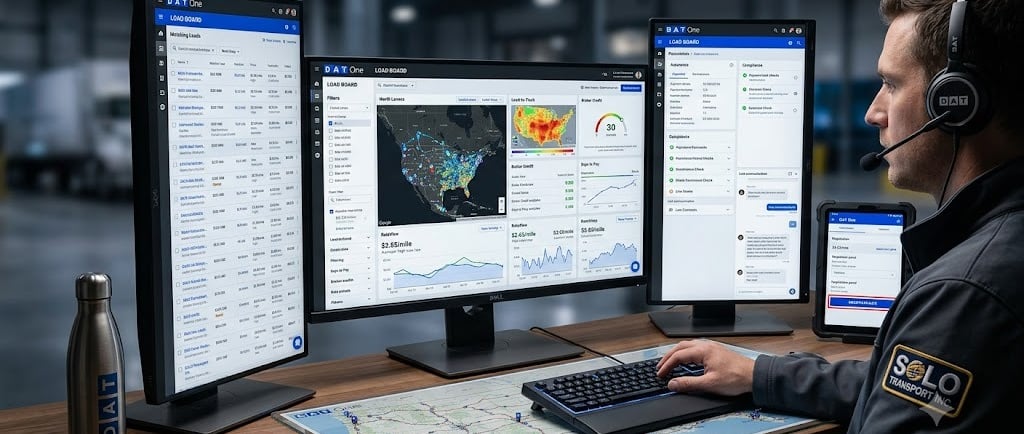
DAT Load Board (2026): Pricing, Features, Login, Pros & Cons — And Whether It's Actually Worth It
Last reviewed: 2026. DAT changes its pricing tiers regularly — always confirm current rates on DAT's site before subscribing.
DAT is the biggest load board in North America, and for a lot of owner-operators it's also the biggest monthly bill they can't quite justify. So let's cut through it.
This guide covers what DAT actually is, what each tier really costs, the one feature that justifies the price (and the tier that doesn't include it), how professional dispatchers use it, where it falls short, and the question most reviews dodge entirely: should you buy DAT, or hire a dispatcher who already has it?
What Is DAT?
DAT — short for Dial-A-Truck — has been around since 1978, which makes it older than most of the trucks running on it. It started at a truck stop in Portland, Oregon, and grew into the largest freight marketplace in North America.
Today the company operates as DAT Freight & Analytics, and their products can get confusing, so here's the plain-English map:
DAT One — the load board itself. This is what carriers and owner-operators subscribe to. When people say "DAT load board," this is it.
DAT Power — the older name for the higher, analytics-heavy carrier/broker tiers. You'll still see "DAT Power load board" used in the wild.
DAT iQ — the deep freight-analytics product, aimed at brokers, shippers, and fleets who live in rate data.
RateView — the rate benchmarking tool inside DAT. This is the important one. More below.
DAT Assurance / broker credit tools — payment history, credit scores, and days-to-pay on the brokers you're considering.
DAT also owns Trucker Tools and Outgo (factoring), and in 2025 it acquired the Convoy Platform from Flexport, which it's folding into DAT One. So "DAT" isn't one product anymore — it's an ecosystem.
Scale check: DAT posts hundreds of millions of loads a year — commonly reported at 500M+ annually, with roughly 700,000 loads posted daily on DAT One. When a broker has freight to move, DAT is usually the first place it goes. That's the whole pitch.
DAT Load Board Pricing (2026)
Here's where most articles fail you. DAT has several carrier tiers, and the cheap one is a trap.
TierApprox. monthlyWhat you getStandard~$49Load search, truck posting, mileage & routing. No rate data.Enhanced~$99Adds broker credit scores, days-to-pay, load counts by state, average lane ratesPro~$149Adds TriHaul (round-trip/triangle routing), shorter-window lane ratesSelect~$199Live auto-refreshing board, market analyticsOffice~$299+Fleet/multi-truck management, back-office tools
Figures are approximate and reported to shift; DAT has been reported anywhere from ~$45 entry to ~$345 at the top fleet tier depending on the source and month. Confirm on DAT's site. Annual billing typically saves around 10–15%.
The Trap: The Entry Tier Has No Rate Data
Read that table again. The cheapest DAT plan doesn't include RateView.
Without rate data, you can see loads — but you have no idea what any lane should pay. You're negotiating on gut instinct against a broker who has the numbers. That's not a discount; that's a handicap.
If you're going to pay for DAT, pay for the tier with rate data. Otherwise you've bought a more expensive version of a free board.
The One Feature That Actually Justifies the Price: RateView
Forget the load listings for a second. Every board has loads. DAT's real product is the rate data.
RateView gives you rolling lane-rate averages built from actual broker-to-carrier transactions — not asking prices. So when a broker offers you $2.10/mile on a lane that's been averaging $2.65, you don't argue from feelings. You argue from the same number the broker is looking at.
Two things make this powerful:
It's the industry benchmark. Brokers recognize RateView numbers as authoritative. Quoting it isn't posturing — it's citing the scoreboard.
It compounds. Operators consistently report RateView adding roughly $0.10–$0.30/mile to their average rate when used in every negotiation. On 8,000 miles a month, even $0.15 is $1,200 — many times the subscription.
The catch: it only works if you actually use it. Paying $149/month and then accepting posted rates without checking the lane average is the single most common way owner-operators waste money on DAT. The subscription isn't the product. The negotiation is.
How Professional Dispatchers Use DAT
Worth understanding, because it's the gap between "having DAT" and "using DAT."
A dispatcher working DAT properly is doing all of this on every load:
Checking the lane average in RateView before making the call — so the counter-offer is ready before the broker finishes their pitch.
Running broker credit and days-to-pay — a great rate from a broker who pays in 90 days (or not at all) isn't a great rate.
Working TriHaul and round-trip logic — building loaded backhauls instead of booking one good load and deadheading out of a dead market.
Watching market condition maps — positioning the truck before rates climb in a hot market, not after.
Cross-checking against Truckstop and their broker network — because some freight never posts on DAT at all.
Moving fast. DAT is the industry default, which means the best-paying loads attract a flood of calls within minutes.
That last point matters more than people realize. A dispatcher is on the platform all day. You're driving. The load doesn't wait for your next fuel stop.
DAT Load Board Login & Common Access Issues
Straightforward, but a few things trip people up:
You log in at DAT's site or through the DAT One mobile app (included with subscriptions) — same credentials for both.
Your MC/DOT authority must be active and in good standing to get carrier access. New authorities occasionally hit verification delays; that's normal, not a bug.
Locked out or seeing the wrong plan features? It's almost always tier-related, not a login bug — the feature you're looking for (usually rate data) may simply not be included in your plan.
Account and billing changes go through DAT support directly. No third-party site can reset your login for you — be extremely careful with any site claiming otherwise. Freight fraud is rampant, and fake login pages are part of it.
DAT Pros
The most freight. Largest network in North America. If a broker posts anywhere, they usually post here first.
RateView is the industry standard. No competitor's rate data carries the same weight in a negotiation.
Broker vetting built in. Credit scores and days-to-pay before you haul, not after you're chasing an invoice.
Strongest for dry van and reefer. Volume dominance in these equipment types is not close.
Best mobile app in the category. Fast, reliable, and it matters when you're booking from the cab.
One ecosystem. Load search, mapping, routing, and trip planning in one place.
DAT Cons
It's the most expensive board, and the meaningful tiers are the expensive ones.
The entry tier is a marketing funnel. No rate data means no real advantage.
Brutal competition. Because everyone's on it, the good loads get buried in calls within minutes. Being fast matters as much as being right.
Not the flatbed king. Truckstop is the open-deck standard — many flatbed and step-deck brokers post there first.
Weak for box trucks, cargo vans, and sprinters. See below — this is the most misunderstood thing about DAT.
Duplicate postings and double-brokering still show up, as they do on every major board.
Learning curve. More filters and data than a beginner needs on day one.
DAT Load Board for Box Trucks: The Honest Answer
A lot of people search this, and the honest answer isn't what DAT's marketing implies.
DAT is architected around full truckload — 53-ft dry van, reefer, and flatbed. Box truck, straight truck, sprinter, and cargo van loads exist on the platform, but they're a thin slice of the volume, and the search experience isn't built to surface them.
If you run a box truck or cargo van, paying premium DAT pricing to compete for a small fraction of the board is often a bad trade. Better fits:
123Loadboard or Direct Freight — cheaper, and proportionally more small-equipment freight.
Expedited-focused platforms and networks — where cargo van and straight-truck freight is the product, not an afterthought.
Amazon Relay — for box truck operators who can meet the requirements.
Rule of thumb: a $150/month board that returns almost nothing for your equipment is more expensive than a $40 board that's full of it.
DAT Alternatives
AlternativeBest forRough costTruckstopFlatbed, step deck, lowbed — the open-deck standard. Book It Now for instant booking.~$40–$160/mo123LoadboardNew/budget carriers, box trucks, hotshot~$35–$65/moDirect FreightRegional and hotshot operators; usable free tier~$45/mo paidTrucker Path (TruckLoads)Free supplemental freightFreeAmazon RelaySteady drop-and-hook power-only work (strict requirements)Free to joinBroker portals (TQL, RXO, Coyote, C.H. Robinson)Free supplements — but only that broker's freightFreeA dispatch serviceNot searching at all — see belowFlat fee or %
Full breakdown of every load board here.
The Real Question: Buy DAT, or Hire a Dispatcher?
This is what you actually came to decide, so let's do the math honestly.
If you buy DAT yourself, here's the true cost:
The subscription — and it has to be a tier with rate data to be worth anything (call it ~$149–$199/month).
Plus a second board if you run flatbed or want full coverage (another ~$100+).
Plus your time. This is the cost nobody puts in the spreadsheet. Searching, calling, negotiating, chasing reloads, vetting brokers, and racing other carriers to the good loads — every day. Hours you're not driving, not resting, not home.
And then there's the ceiling: the board only shows you the freight everyone else can see. Posted rates run below what experienced carriers negotiate, and the best loads — the ones with the good shippers and the real money — often never hit a public board at all. They go to carriers with dispatch relationships.
If you hire a dispatch service instead: you don't need the subscription. We already have DAT — including the rate data. You get the benefit of the analytics, the broker credit checks, the market maps, and the negotiation, without paying for the platform, learning it, or living on it.
That's the part that flips the math. You're not choosing between "$149/month" and "a dispatch fee." You're choosing between paying for a tool and operating it yourself in your off-hours — or paying someone to operate it, plus their broker network, plus their negotiation, while you drive.
Which one is right for you?
Buy DAT if: you genuinely enjoy the booking side, you'll commit to using RateView on every single negotiation, and your time on the board is worth more than your time on the road.
Hire a dispatcher if: you'd rather drive, you want your evenings back, and you want someone negotiating every load with the data in front of them — while you keep your authority and the final say.
Where Five Star Dispatching Comes In
We're already on the boards. We already have the rate data. We already know what your lane pays before we pick up the phone.
Five Star Dispatching finds your freight, negotiates every rate instead of accepting the posted number, vets brokers before you roll, and plans around deadhead so your empty miles stay low. You keep your authority. You keep the final say on every load. You skip the subscription, the learning curve, and the evenings lost to scrolling.
We dispatch dry van, reefer, flatbed, power only, and hotshot for owner-operators and small fleets nationwide.
Ready to stop paying for a load board and start hauling better freight? 👉 Visit fivestardispatching.com and let's get your wheels turning.
The Bottom Line
DAT is the best load board in the business — if you buy the tier with rate data and actually use it on every negotiation. It's the largest network, the industry-standard rate benchmark, and the strongest option for dry van and reefer.
But it's a tool, not a strategy. It won't call brokers. It won't negotiate. It won't find you the freight that never gets posted. And it won't give you your evenings back.
Know which of those problems you're actually trying to solve — then buy accordingly.
Frequently Asked Questions
What is the DAT load board?
DAT One is North America's largest truckload freight marketplace, run by DAT Freight & Analytics (founded 1978). Carriers subscribe to search loads, post trucks, check broker credit, and access RateView lane-rate data.
How much does the DAT load board cost in 2026?
Carrier tiers commonly run from roughly $49/month (Standard, no rate data) up to around $299+/month for fleet tiers, with the mid-tiers around $99–$199. Pricing shifts frequently — confirm on DAT's site. Annual billing typically saves 10–15%.
Is the cheapest DAT plan worth it?
Usually not. The entry tier excludes rate data, which means you can see loads but not what they should pay. If you're paying for DAT, pay for a tier that includes rate benchmarks.
Is DAT worth it for owner-operators?
If you run the spot market daily and use RateView in every negotiation, yes — operators commonly report it adding $0.10–$0.30/mile, which more than covers the cost. If you rarely negotiate or run a niche equipment type, you may be overpaying.
How do I log in to DAT?
Through DAT's website or the DAT One mobile app with the same credentials. Carrier access requires active MC/DOT authority in good standing. Be cautious of any third-party site offering to reset DAT credentials — freight fraud is common.
Is DAT good for box trucks?
Not especially. DAT is built around full truckload freight (53-ft van, reefer, flatbed). Box truck, sprinter, and cargo van loads are a thin slice of the board. 123Loadboard, Direct Freight, or expedited-specific platforms are usually a better fit.
What's the difference between DAT One, DAT Power, and DAT iQ?
DAT One is the load board carriers subscribe to. "DAT Power" refers to higher analytics-heavy tiers. DAT iQ is the deep freight-analytics product aimed at brokers, shippers, and fleets.
Should I buy DAT or hire a dispatcher?
Buy DAT if you want to book your own freight and will use the rate data on every load. Hire a dispatcher if you'd rather drive — a dispatch service already has DAT and its analytics, plus a broker network, so you get the benefit without the subscription or the hours on the board.
Reach out anytime for reliable dispatch support.
Conect Now
Newesletter
© 2025. All rights reserved.

