
Best Load Boards for Truckers in 2026: All 20+ Compared
DAT vs Truckstop vs Amazon Relay vs Sylectus and 20+ more load boards compared for 2026 — real pricing, best board by equipment type, free options, and what happened to Convoy.
TRUCKING INDUSTRY
Five Star Dispatching
7/12/20268 min read
Best Load Boards for Truckers in 2026: DAT vs Truckstop vs Amazon Relay vs Sylectus (and 20+ More)
There is no single "best" load board. Anyone who tells you otherwise is selling something.
The right board depends on what you haul, where you run, and what you can afford — and the flatbedder swearing by Truckstop would hate running dry van on it. So instead of crowning a winner, this guide does something more useful: it tells you which board wins for your equipment, what each one actually costs, which "load boards" aren't really load boards at all, and — the part nobody says out loud — why the best-paying freight often never hits a board in the first place.
Let's go.
The Quick Answer (If You're Reading From the Cab)
You run…Use thisDry van or reeferDAT One — biggest load volume, best rate dataFlatbed, step deck, lowbedTruckstop — the open-deck industry standardHotshot or box truck123Loadboard or Direct Freight — better value for smaller freightPower only / drop-and-hookDAT + Amazon RelayExpedited / team / sprinterSylectus (network-based, not public)Just starting, tight budget123Loadboard, plus free Trucker Path / TruckSmarterWant the best freight, periodLoads that never hit a board — see the last section
The Two That Actually Matter: DAT vs Truckstop
Together, DAT and Truckstop dominate digital freight matching for carriers. Everything else is a supplement.
DAT One — The Industry Standard
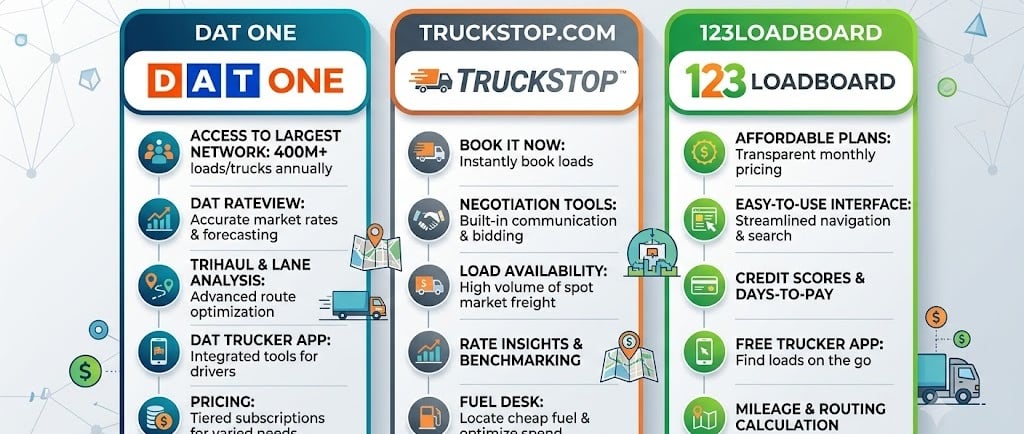
DAT One is DAT's flagship subscription load board, with nearly 700,000 loads posted daily. DAT has been around since 1978 and runs the largest freight network in North America, with over 500 million loads posted annually — when brokers need to move freight, most post to DAT first.
But the real reason pros pay for DAT isn't the listings — it's the rate data. DAT RateView gives you 13-month rate averages for every lane in the country. When a broker offers $2.10/mile on a lane averaging $2.65, you have the data to push back — and that one feature can add $0.10–$0.30/mile to your average rate if you use it in every negotiation. RateView is the benchmark brokers themselves reference, so when you quote it, they recognize it as authoritative.
Best for: Dry van and reefer — DAT dominates volume in these equipment types.
Pricing: Tiered; commonly cited in the $50–$250/month range depending on plan. Confirm current pricing with DAT.
Weakness: Cost, a steeper learning curve, and heavy competition — because DAT is the industry default, the best-paying loads attract a lot of calls fast.
Truckstop — The Open-Deck King
Truckstop is DAT's only real competitor, and in one category it doesn't just compete — it wins outright.
Truckstop has a notably stronger presence in flatbed and specialized freight, and many flatbed brokers prefer posting there. One flatbed operator put it bluntly: Truckstop handles nearly all of his lowbed loads. The open-deck industry knows Truckstop is the main source for that freight.
Its other edge is Book It Now — instant one-click booking with no phone call. The trade-off: those rates are fixed and non-negotiable, while DAT's call-based booking rewards a good negotiator who can often pull $50–$200 more per load than posted. Speed vs. negotiation. Pick your style.
Best for: Flatbed, step deck, lowbed, hot shot.
Pricing: Tiered, generally $40–$160/month; typically a bit cheaper than DAT at each tier.
Bonus: Truckstop blocks brokers from listing the same load multiple times with bogus locations — a real fraud advantage.
Should You Run Both?
Most serious owner-operators subscribe to both, because some lanes have more loads on DAT and others on Truckstop. The math is simple: negotiate $0.10/mile more on a 500-mile load using rate data and that's $50 — three loads like that covers a subscription with profit left over.
The Budget Tier: 123Loadboard, Direct Freight, Trucker Path
You don't need to spend $250/month to get started.
123Loadboard — the best value for new carriers, roughly $35–$65/month with unlimited searches and credit checks. Start here, then upgrade to DAT or Truckstop when you need volume. It serves over 325,000 transportation professionals.
Direct Freight — posts over 300,000 loads daily; free tier has limited features, paid plans start around $45/month. Solid for regional operators and hotshot drivers.
Trucker Path (TruckLoads) — unlimited free load board access with 150,000+ loads daily, plus GPS, document tools, and a community of 600,000+ drivers. Good for supplemental freight between your regular loads.
Free Load Boards: Worth It or a Trap?
Free boards are a supplement, not a strategy. They offer real volume — 150,000–300,000 loads daily — but often lower-paying freight and less reliable brokers. The bigger problem: you get no rate data or market analytics, which means you're negotiating blind, with no idea what the load should pay.
Technically you can run on free boards alone — but you'll struggle. Most successful owner-operators use at least one paid board plus free options as backup.
Free options worth having: Trucker Path TruckLoads, TruckSmarter, Direct Freight (basic), uShip (free listings, per-transaction fee).
Amazon Relay: Steady Freight, Strict Rules
Amazon Relay is Amazon's own carrier platform — you're hauling Amazon's freight, often drop-and-hook power-only work between fulfillment centers.
Upside: consistent, high-volume, dedicated-style freight and fast pay. Great for power-only operators who want predictable turns.
Downside: a good dedicated freight option if you can meet Amazon's requirements — and those requirements are strict (equipment standards, performance metrics, on-time scores). Rates are set, not negotiated.
Verdict: excellent as a base load of steady freight; weak as your only source, because you give up rate negotiation entirely.
Sylectus: The One Most Truckers Can't Just Join
Sylectus isn't a public load board — it's a closed network used primarily by expedited carriers, team drivers, sprinter/cargo van operators, and the time-critical freight world. Carriers inside the network share and tender loads to each other.
Best for: expedited, team, and van/straight-truck operators running time-critical freight.
Reality check: access typically comes through membership/qualification, not a $50 signup. If you're a solo dry van owner-operator, this isn't your board.
Why it's on your radar: expedited freight pays a premium — but the barrier to entry is the point.
"TQL Load Board," "Landstar," "RXO," "XPO," "Coyote" — These Aren't Load Boards
This is where a lot of new owner-operators get confused, so let's be precise.
TQL, RXO, XPO, Coyote (UPS), C.H. Robinson (Navisphere), and Uber Freight are freight brokers — not neutral load boards. What you're searching for is their carrier portal: a private board showing their own freight only.
The upside: free to use, no subscription, and you're dealing directly with the broker holding the load.
The catch: you only see one broker's freight, and posted rates are often take-it-or-leave-it. Even the big "free" broker portals from C.H. Robinson and J.B. Hunt are just that — one company's loads. Uber Freight is easy to use, but rates can run below the open market — good for filling gaps, not as your primary freight source.
Landstar is different still. Landstar's load board is for its own leased owner-operators (BCOs) and agents — you can't just subscribe to it as an outside carrier. You have to lease on with Landstar. That's a business model decision, not a load board decision.
Bottom line: run broker portals alongside a real load board, never instead of one. And remember whose side they're on — a broker works for the shipper. That's the whole difference between a broker and a dispatcher.
What Happened to the Convoy Load Board?
Still searching for Convoy? Here's the honest history, because most "2026" lists still get this wrong.
Convoy shut down in late 2023, and its assets and some employees were acquired by Flexport. The collapse left carriers unpaid — some reported being owed thousands for loads completed in the final days. Flexport relaunched the Convoy load board platform in February 2024, and then in July 2025, DAT Freight & Analytics agreed to acquire the Convoy Platform from Flexport. DAT is integrating it into DAT One, giving carriers a faster way to find quality loads from trusted brokers.
Translation for you: Convoy as an independent load board is gone. Its technology now lives inside DAT. If you were looking for Convoy, DAT One is where you go.
The lesson is bigger than one company: platforms come and go, and carriers eat the loss when they collapse. Relationships don't disappear overnight. Platforms do.
The Warning Nobody Puts in a Load Board Comparison
Here's the part that should change how you use every board above.
Load boards are the most competitive, lowest-margin place to find freight. Everyone sees the same listings. Brokers know it. And publicly posted rates typically run 10–20% below what experienced carriers negotiate — so if you're consistently accepting posted rates, you're leaving thousands on the table every year.
Worse: the best freight — top-dollar loads with reliable shippers — often never hits a load board at all. Those loads go to carriers with professional dispatch relationships.
Load boards are tools, not strategies. The carriers earning the most per mile aren't browsing DAT — they're getting calls with loads already negotiated.
That's not an argument against load boards. It's an argument against living on them.
Where Five Star Dispatching Comes In
Load boards help you find freight. A dispatcher helps you book higher-paying freight without spending hours searching for it.
That's the whole difference. We run the boards and the broker network for you — we know the market rate before we call, we negotiate every load instead of accepting the posted number, we vet brokers before you roll (so no Convoy-style surprises), and we plan around deadhead so your empty miles stay low. You keep your authority and the final say on every load. You just stop spending your evenings scrolling.
We dispatch dry van, reefer, flatbed, power only, and hotshot for owner-operators and small fleets nationwide. Here's what a real dispatcher actually does.
Ready to stop hunting loads and start hauling them? 👉 Visit fivestardispatching.com and let's keep your truck loaded.
The Bottom Line
Pick your board by equipment first, price second: DAT for dry van and reefer, Truckstop for open deck, 123Loadboard or Direct Freight if you're starting lean, Amazon Relay for steady power-only turns, Sylectus if you're in the expedited world. Run a free board as backup. Treat broker portals as a supplement, never a strategy.
Then remember what none of them will tell you: the board shows you the freight everyone else can see. The money is in what you do next — negotiating it, or having someone negotiate it for you.
Frequently Asked Questions
What is the best load board for truckers in 2026?
There's no universal winner — it depends on your equipment. DAT One is best for dry van and reefer (largest volume and the industry-standard RateView rate data). Truckstop is best for flatbed, step deck, and open deck. 123Loadboard and Direct Freight offer the best value for new or budget-conscious carriers.
DAT vs Truckstop — which should I pay for?
If you can only pick one, DAT One's combination of the largest load volume and industry-standard rate data makes it the more versatile platform — unless you run flatbed or step deck, where Truckstop's open-deck dominance wins. Many serious operators subscribe to both.
How much do load boards cost?
Roughly free to $250/month. DAT and Truckstop are the premium tiers; 123Loadboard runs around $35–$65/month; Trucker Path and Direct Freight offer free tiers. Pricing changes often — confirm on each provider's site.
Are free load boards worth using?
As a supplement, yes. Free boards like Trucker Path and Direct Freight's basic tier post large volumes, but often carry lower-paying freight and less reliable brokers, and they give you no rate data — which means negotiating blind.
Is the TQL / RXO / XPO / Coyote load board a real load board?
No. Those are freight broker carrier portals showing only that broker's own freight. They're free and useful as a supplement, but they aren't neutral marketplaces, and the rates are often take-it-or-leave-it.
What happened to the Convoy load board?
Convoy shut down in late 2023 and its assets went to Flexport, which relaunched the platform in 2024. In July 2025, DAT agreed to acquire the Convoy Platform and is integrating it into DAT One. Convoy no longer exists as an independent load board.
What is Sylectus?
A closed network used mainly by expedited, team, and sprinter/cargo van carriers to share time-critical freight. It's membership-based, not a public subscription board.
Do I still need a load board if I have a dispatcher?
Not for finding loads — your dispatcher works the boards and their broker network for you. Having your own access lets you verify rates and understand the market, but you don't need to search yourself.
Reach out anytime for reliable dispatch support.
Conect Now
Newesletter
© 2025. All rights reserved.

