
Is Paying an 8% Dispatch Fee Actually Worth It? Here's the Real Answer
An 8% dispatch fee sounds like a lot until you actually run the numbers. Here's a straightforward breakdown of what you get for that fee, and when it does — and doesn't — make financial sense.
TRUCK DISPATCH SERVICETRUCK DISPATCHER
Five Star Dispatching
7/21/20263 min read
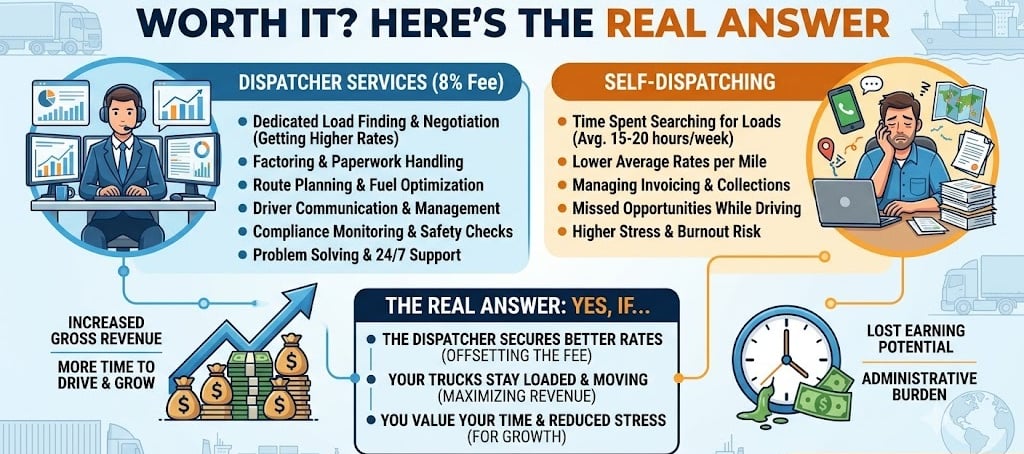
Every owner-operator asks this question at some point: is handing over 8% of your gross revenue actually worth it, or is it money you could keep by doing the work yourself? It's a fair question, and the honest answer is: it depends — but for most solo operators, the math tends to favor paying it. Here's why, with real numbers instead of vague reassurance.
Let's Do the Actual Math
Say you're grossing $6,000 a week. An 8% dispatch fee comes out to $480 a week — real money, no argument there. The question isn't whether that's a cost. It's whether what you get back is worth more than $480.
Here's where that number typically gets made back, and then some:
Rate negotiation. If a dispatcher negotiates even $0.05–$0.10 more per mile than you'd get accepting posted rates, and you're running 2,000 miles a week, that's $100–$200 recovered right there — before anything else.
Reduced deadhead miles. Better route planning that cuts even 100 deadhead miles a week saves fuel costs and adds a load's worth of revenue you'd otherwise have missed sitting empty between deliveries.
Time saved. If negotiating loads, vetting brokers, and doing paperwork yourself costs you 8–10 hours a week, that's time you could spend driving more miles, resting properly, or — frankly — not burning out.
Add those up, and the fee often pays for itself before you even factor in the reduced stress of not managing everything solo.
When the Fee Is Genuinely Worth It
You're running solo and don't have hours in the day to negotiate every load and vet every broker.
You value consistency over occasionally landing a great load yourself but sitting idle more often in between.
You want to scale — adding a second or third truck is far more manageable with dispatch support than trying to self-dispatch multiple trucks.
You're newer to the industry and don't yet have the market knowledge to know what a load should pay.
When It Might Not Be Worth It
You genuinely enjoy negotiating and have built strong direct broker relationships over years in the business.
You have the time to actively monitor multiple load boards throughout the day without it cutting into drive time.
You're running a very short, predictable local route where load variability and negotiation matter less.
For carriers in this second bucket, self-dispatching can work fine. But it's a smaller group than most people assume — most solo owner-operators underestimate how much time and expertise a dispatcher is actually saving them.
What Separates a Fee Worth Paying from One That Isn't
Not all 8% fees deliver the same value. The fee is worth it when the dispatcher is:
Actually negotiating rates, not just accepting posted numbers
Vetting brokers before booking, protecting you from non-paying freight
Planning routes to minimize deadhead miles
Handling paperwork and check calls so you're not doing admin at 11pm
The fee is not worth it if a "dispatcher" is simply forwarding load board listings without negotiation or vetting — at that point, you're paying for something you could do yourself with a load board subscription.
A Quick Way to Test It
If you're on the fence, track two things for a month: your average rate per mile and your average deadhead miles per week, both before and after switching to a dispatch service. If negotiated rates go up and deadhead miles go down enough to outweigh the fee, it's working. If neither moves, that's a sign the service isn't delivering — and a legitimate dispatcher should welcome that kind of scrutiny.
Frequently Asked Questions
Is 8% a standard dispatch fee?
Dispatch fees commonly fall somewhere in the 5–10% range of gross revenue per load, with 8% being a fairly common figure across the industry.
Do dispatch fees apply to every load or just some?
Typically the fee applies to every load booked through the dispatcher, calculated as a percentage of that load's gross revenue.
Can I negotiate the dispatch fee itself?
Some services are open to adjusting fees based on volume or a long-term working relationship, though this varies by provider.
How do I know if my dispatch fee is actually paying for itself?
Compare your rate per mile and deadhead miles before and after starting with a dispatcher. If negotiated rates are meaningfully higher and idle time is lower, the fee is generally justified.
Want to See the Math for Yourself?
Five Star Dispatching negotiates every load, vets every broker, and plans routes to cut deadhead miles — the kind of work that makes an 8% fee pay for itself many times over.
Talk to our team today and find out what a properly negotiated rate actually looks like for your lanes.
Related reading: What Does a Truck Dispatcher Actually Do? | Truck Dispatch Services Explained Without the Industry Jargon
External resources: FMCSA Owner-Operator Resources | DAT Freight & Analytics
Reach out anytime for reliable dispatch support.
Conect Now
Newesletter
© 2025. All rights reserved.

