
How Owner Operators Can Stay Loaded Every Week
An empty truck is a truck losing money. Here's a practical breakdown of what it actually takes to stay consistently loaded week after week — not just occasionally landing a good haul.
OWNER OPERATORTRUCKING INDUSTRY
Five Star Dispatching
7/26/20263 min read
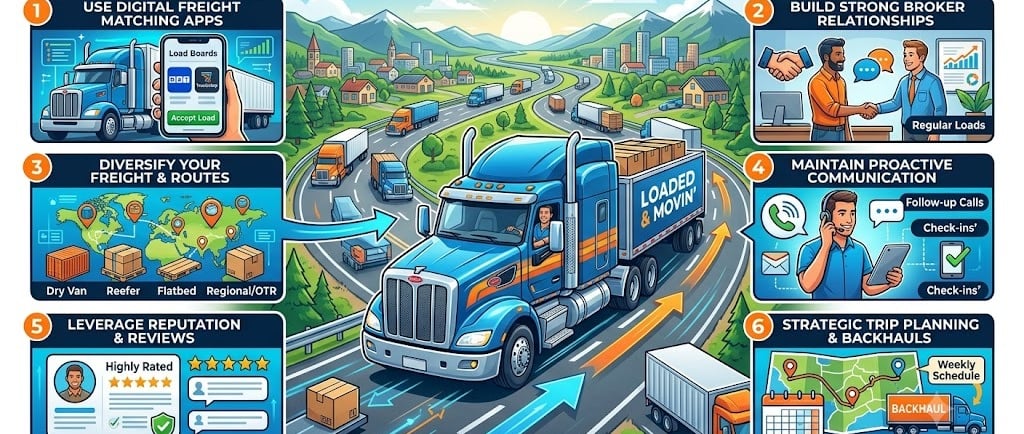
Any owner-operator can land a great load once in a while. The real challenge — and the real difference between a profitable year and a stressful one — is staying consistently loaded, week after week, without long gaps of sitting idle. Here's what that actually takes.
Book Your Next Load Before Your Current One Delivers
The single biggest mistake that leads to empty days is waiting until after delivery to start looking for the next load. By the time you're unloaded and searching, you're already losing hours or even a full day. The fix is simple in concept, harder in practice: start lining up your next load while you're still en route to your current delivery. This is exactly the kind of forward planning a dispatcher does as a matter of routine.
Diversify Your Load Sources
Relying on a single load board means competing with every other carrier searching that same board at the same time. Staying loaded consistently usually means working multiple sources — major load boards like DAT and Truckstop, niche or regional boards suited to your equipment, and ideally, direct relationships with brokers and shippers who call you first before a load even hits a public board.
Build Repeat Relationships, Not Just One-Off Bookings
A single good load from a broker is fine. A broker who calls you first every week because you've delivered reliably and communicated well is far more valuable. Consistency comes from being the carrier a broker trusts to handle their freight without issues — on-time pickups, proactive communication, and no last-minute surprises build that reputation over time.
Know Your Lanes and Plan Around Them
Carriers who stay loaded consistently usually aren't chasing freight randomly across the country — they know their strongest lanes, the regions where freight density is high, and they plan routes that keep them moving through those areas rather than deadheading into freight deserts. Understanding seasonal freight patterns for your equipment type (produce season for reefer, construction season for flatbed and hotshot, e-commerce peaks for box trucks and cargo vans) also helps you anticipate demand instead of reacting to it.
Set a Realistic Rate Floor — and Stick to It Without Being Rigid
Staying loaded doesn't mean taking every load offered. Taking a load at a rate that barely covers fuel just to avoid sitting idle often costs more in the long run than a day of downtime. At the same time, an unrealistic rate floor that ignores current market conditions can leave you sitting idle unnecessarily. The balance comes from knowing current market rates for your lanes and equipment, and adjusting expectations based on real data, not guesswork.
Track Your Deadhead Miles
Deadhead miles are the silent profit killer. A load that pays well but requires 200 empty miles to reach might actually be less profitable than a lower-paying load positioned closer to your current location. Carriers who stay consistently loaded are usually tracking this ratio closely and factoring it into every decision, not just looking at the headline rate.
Consider Working With a Dispatcher
This is, frankly, the fastest way to solve the consistency problem for most solo owner-operators. A dispatcher is doing all of the above — forward planning, working multiple load sources, building broker relationships, negotiating rates, and tracking deadhead miles — as their full-time job, while you focus on driving. It's the difference between trying to do all of this reactively between drives versus having someone doing it proactively in the background at all times.
Frequently Asked Questions
How far in advance should I be looking for my next load?
Ideally, you should start searching for your next load while still en route to your current delivery, rather than waiting until after you've unloaded.
Is it better to work with one broker consistently or spread across many?
A mix works best — repeat relationships with a few trusted brokers provide consistency, while staying active on load boards and with other contacts keeps your options open when regular lanes are slow.
What's a reasonable amount of deadhead to accept?
There's no fixed number since it depends on the load's rate and your lane, but generally the goal is to keep deadhead miles low enough that they don't erode the load's profitability once fuel and time are factored in.
Can a dispatcher really keep me loaded more consistently than I could myself?
For most solo owner-operators, yes — a dispatcher is actively working load sourcing, negotiation, and route planning as a full-time task, which is difficult to match while also driving.
Tired of Gaps Between Loads?
Five Star Dispatching plans your next load before your current one even delivers — keeping your truck moving and your schedule full, week after week.
Get in touch with our team today and see what consistent booking actually looks like.
Related reading: The Truth About Hiring a Truck Dispatcher as an Owner Operator | What Good Dispatchers Do That Load Boards Never Will
External resources: DAT Freight & Analytics | FMCSA Owner-Operator Resources
Reach out anytime for reliable dispatch support.
Conect Now
Newesletter
© 2025. All rights reserved.

